Why Emails Fail Us So Often

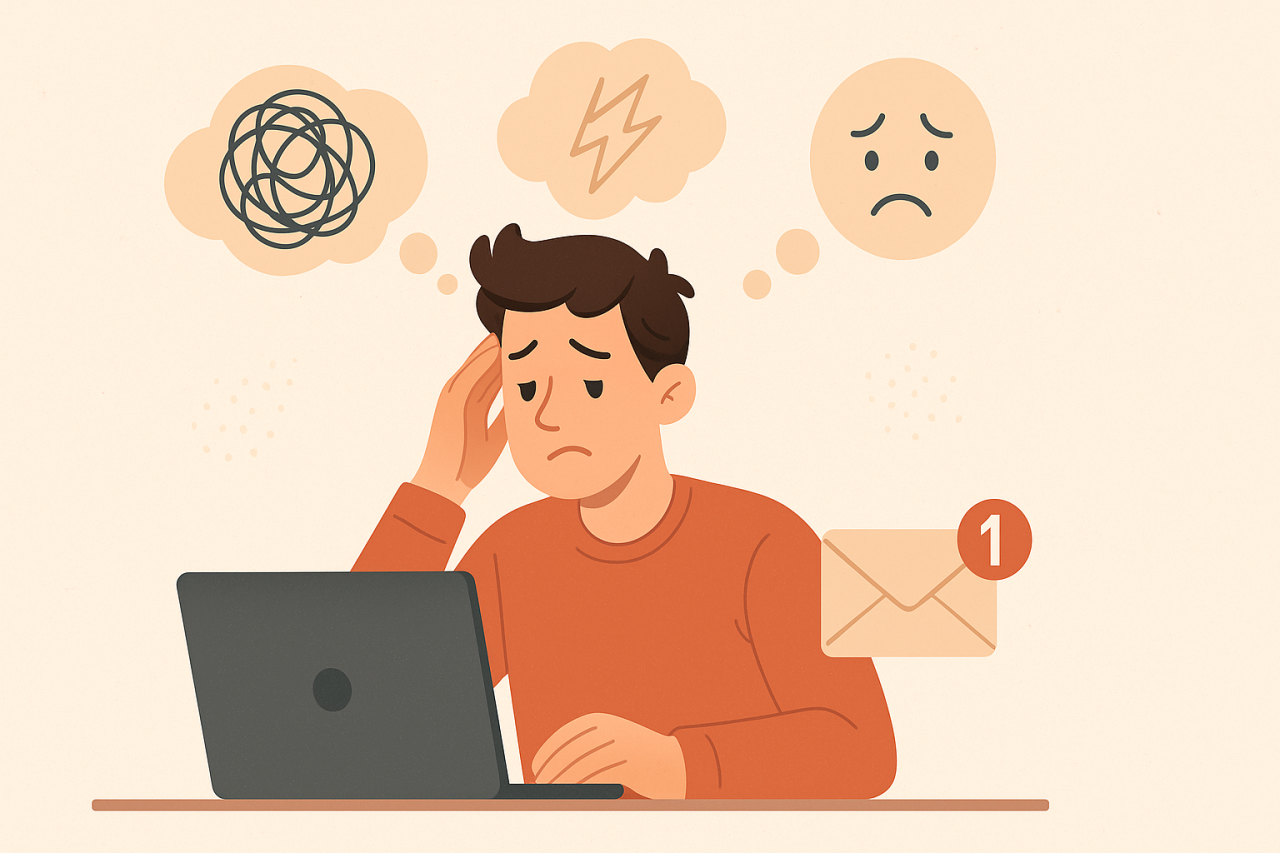
Have you ever written an email when you were frustrated and realized afterwards that too much emotion leaked through the words of that email? And now it's a permanent record of how you were feeling in that moment, something that the recipient will read and analyze a hundred times, parsing every word, and coming to their own conclusion as to what you were intending.
Over the years I've learned an important lesson when it comes to written correspondence.
Emails aren't for emotions.
Emails are for information transfer only.
When something requires more nuanced understanding, we need to have that conversation face to face.
That's because so much of our communication is non-verbal and dynamic. And our emails are one dimensional and flat. We can't see people's body language or hear their tone when we just read their words. And so in our minds we fill in what we "assume" their body language and tone was like. . . and we often get it wrong!
Studies indicate that a significant amount of email communication is missed, largely due to the absence of non-verbal cues. One study found that while people believe their emails are understood 90% of the time, the actual comprehension rate is often only 50%. That means 1 out of 2 emails are not understood as intended.
Research suggests that in face-to-face conversations, 93% of communication is non-verbal (55% body language and facial expressions, 38% vocal tone) and only 7% is conveyed through words alone. Email, being a one-dimensional, text-based medium, lacks these crucial non-verbal elements, making it prone to misinterpretation of tone and intent.
Without the ability to hear our voice or see our face, a message intended as neutral (e.g., "Please address this by Friday") can come across as cold or demanding. As recipients, we often project our own emotions and assumptions onto the text, frequently assuming the worst when intent is unclear (a "negative bias").
In light of this, and with years of personal experience of emails leading to misunderstandings, I find myself keeping emails short and factual. More than ever I am picking up the phone or starting a visual Teams Call or walking into a teammates office to have face to face conversations.
The other benefit of this is we find ourselves opening healthy back and forth dialogues, which is what conversation is, as opposed to one-sided monologues, which is the essence of email.
So the next time we click "Create New Email" (and statistics say that averages 40 times per day) we would do well to focus on facts, not emotions. Keep it simple, information transfer. And let the more nuanced, emotional conversations happen face to face.
I'd love to know your experience with email misunderstandings. . . drop a comment below.
When you subscribe to the blog, we will send you an e-mail when there are new updates on the site so you wouldn't miss them.

Comments